BIOGRAPHY
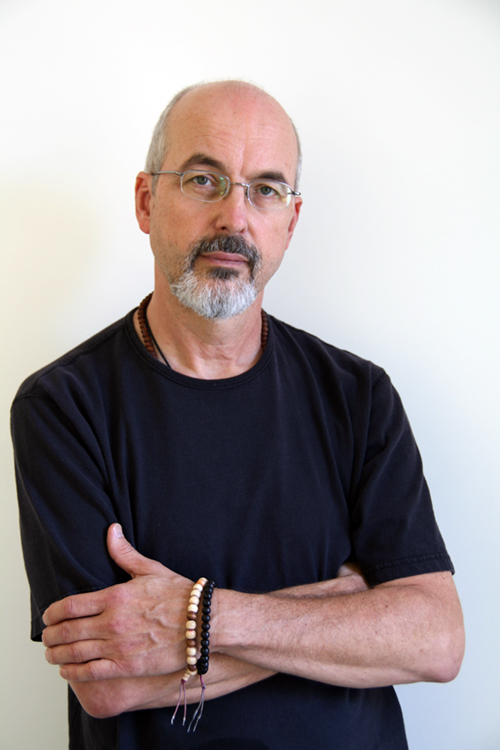
Photo: Kira Perov © Bill Viola Studio
Bill Viola (b.1951) is internationally recognized as one of today’s leading artists. He has been instrumental in the establishment of video as a vital form of contemporary art, and in so doing has helped to greatly expand its scope in terms of technology, content, and historical reach. For 40 years he has created videotapes, architectural video installations, sound environments, electronic music performances, flat panel video pieces, and works for television broadcast. Viola’s video installations—total environments that envelop the viewer in image and sound—employ state-of-the-art technologies and are distinguished by their precision and direct simplicity. They are shown in museums and galleries worldwide and are found in many distinguished collections.
His single channel videotapes have been widely broadcast and presented cinematically, while his writings have been extensively published, and translated for international readers. Viola uses video to explore the phenomena of sense perception as an avenue to self-knowledge. His works focus on universal human experiences—birth, death, the unfolding of consciousness—and have roots in both Eastern and Western art as well as spiritual traditions, including Zen Buddhism, Islamic Sufism, and Christian mysticism. Using the inner language of subjective thoughts and collective memories, his videos communicate to a wide audience, allowing viewers to experience the work directly, and in their own personal way.
Bill Viola received his BFA in Experimental Studios from Syracuse University in 1973 where he studied visual art with Jack Nelson and electronic music with Franklin Morris. During the 1970s he lived for 18 months in Florence, Italy, as technical director of production for Art/Tapes/22, one of the first video art studios in Europe, and then traveled widely to study and record traditional performing arts in the Solomon Islands, Java, Bali, and Japan. Viola was invited to be artist-in-residence at the WNET Channel 13 Television Laboratory in New York from 1976-1980 where he created a series of works, many of which were premiered on television. In 1977 Viola was invited to show his videotapes at La Trobe University (Melbourne, Australia) by cultural arts director Kira Perov who, a year later, joined him in New York where they married and began a lifelong collaboration working and traveling together.

Chott el-Djerid (A Portrait in Light and Heat), 1979. Photo: Kira Perov © Bill Viola Studio
In 1979 Viola and Perov traveled to the Sahara desert, Tunisia to record mirages. The following year Viola was awarded a U.S./Japan Creative Artist Fellowship and they lived in Japan for a year and a half where they studied Zen Buddhism with Master Daien Tanaka, and Viola became the first artist-in-residence at Sony Corporation’s Atsugi research laboratories. Viola and Perov returned to the U. S. at the end of 1981 and settled in Long Beach, California, initiating projects to create art works based on medical imaging technologies of the human body at a local hospital, animal consciousness at the San Diego Zoo, and fire walking rituals among the Hindu communities in Fiji. In 1987 they traveled for five months throughout the American Southwest photographing Native American rock art sites, and recording nocturnal desert landscapes with a series of specialized video cameras. More recently, at the end of 2005, they journeyed with their two sons to Dharamsala, India to record a prayer blessing with the Dalai Lama.
Music has always been an important part of Viola’s life and work. From 1973-1980 he performed with avant-garde composer David Tudor as a member of his Rainforest ensemble, later called Composers Inside Electronics. Viola has also created videos to accompany music compositions including 20th century composer Edgard Varèse’ Déserts in 1994 with the Ensemble Modern, and, in 2000, a three-song video suite for the rock group Nine Inch Nails’ world tour. In 2004 Viola began collaborating with director Peter Sellars and conductor Esa-Pekka Salonen to create a new production of Richard Wagner’s opera, Tristan und Isolde, which was presented in project form by the Los Angeles Philharmonic in December 2004, and later at the Lincoln Center for the Performing Arts, New York (2007). The complete opera received its world premiere at the Opéra National de Paris, Bastille in April 2005.
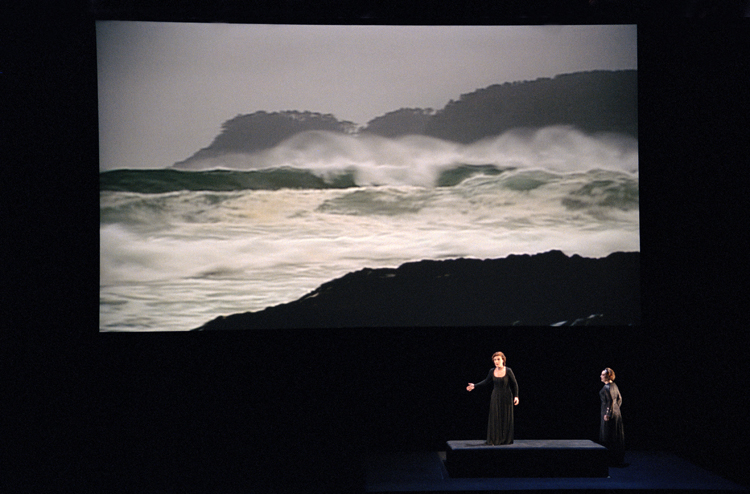
Peter Sellar's production of Richard Wagner's Tristan und Isolde, with 4-hour video by Bill Viola
Premiere performance, Opéra National de Paris, 2005. Photo: Ruth Walz
Since the early 1970s Viola’s video art works have been seen all over the world. Exhibitions include Bill Viola: Installations and Videotapes, Museum of Modern Art, New York, 1987; Bill Viola: Unseen Images, seven installations toured six venues in Europe, 1992-1994, organized by the Kunsthalle Düsseldorf and Kira Perov. Viola represented the U.S. at the 46th Venice Biennale in 1995 with Buried Secrets, a series of five new installation works. In 1997 the Whitney Museum of American Art organized Bill Viola: A 25-Year Survey that included over 35 installations and videotapes and traveled for two years to six museums in the United States and Europe. In 2002 Viola completed his most ambitious project, Going Forth By Day, a five part projected digital “fresco” cycle, his first work in High-Definition video, commissioned by the Deutsche Guggenheim Berlin and the Guggenheim Museum, New York. Bill Viola: The Passions, a new series inspired by late medieval and early Renaissance art, was exhibited at the J. Paul Getty Museum, Los Angeles in 2003 then traveled to the National Gallery, London, the Fondación “La Caixa” in Madrid and the National Gallery of Australia, Canberra.
One of the largest exhibitions of Viola’s installations to date, Bill Viola: Hatsu-Yume (First Dream) (2006-2007), drew over 340,000 visitors to the Mori Art Museum in Tokyo. In 2007 nine installations were shown at the Zahenta National Gallery of Art, Warsaw; and Ocean Without a shore was created for the 15th century Church of San Gallo during the Venice Biennale. In 2008 Bill Viola: Visioni interiori, a survey exhibition organized by Kira Perov, was presented in Rome at the Palazzo delle Esposizioni. In 2014, twenty works were shown at the Grand Palais, Paris, in his largest survey exhibition to date, and a few months later, part one of the St. Paul’s commission was installed in the London cathedral, Martyrs (Earth, Air, Fire, Water).
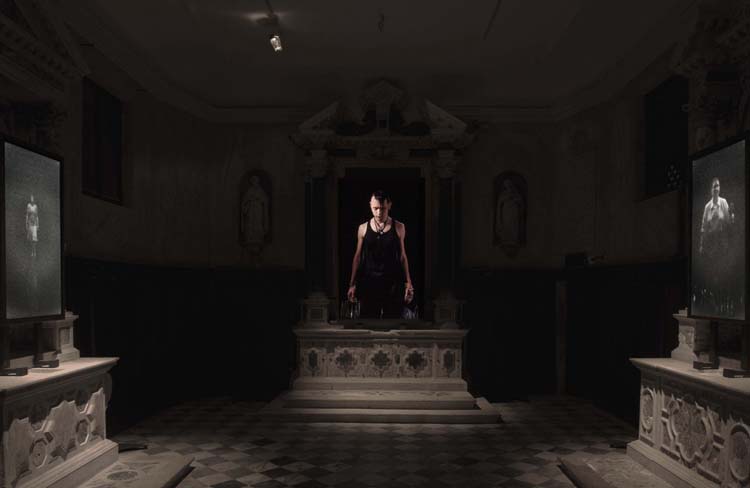
Ocean Without a Shore, 2007, installation view, Church of San Gallo, Venice, Italy. Photo: Thierry Bal
Yorkshire Sculpture Park in West Yorkshire, UK, presented a large exhibition of installations in its chapel and galleries in 2015. Vinyl Factory also produced the first Viola LP, The Talking Drum that year, featuring sound works from 1979-82, presenting them in an underground car park in London. The first Viola monograph summarizing forty years of creative output, edited by Kira Perov with text by John G. Hanhardt, was published by Thames & Hudson, and later reprinted in German (Sieveking Verlag), Spanish with Basque insert (La Fábrica, Bilbao, 2017), and Portuguese (SESC, Brazil, 2018). Mary, the second part of the commission for St. Paul’s Cathedral was installed in London, 2016, and Viola’s first large exhibition in Washington D. C. opened at the National Portrait Gallery the same year. Four large-scale exhibitions and two smaller shows were organized for 2017: at the Palazzo Strozzi, Florence; in the Deichtorhallen, Hamburg; Guggenheim Bilbao Museum presented a “retrospective” of works ranging from 1976 to 2014, the largest show to date, with the greatest attendance; Redtory Museum of Contemporary Art, Guangzhou, China and exhibitions in Uppsala Cathedral, Sweden, and Montreal (DHCArt) filled out the year.
In 2018, SESC (Serviço Social do Comécio) in São Paulo presented a group of 12 works for the opening of their new facility, Sesc Avenida Paulista. A reprise of Wagner’s Tristan und Isolde, Peter Sellars’ production with 4-hours of video was part of the 2018 season at the Opéra National de Paris with nine performances. “Vía Mistica,” an exhibition occupying four venues in the ancient city of Cuenca, Spain, was installed in three churches and the Museo de Arte Abstracto, a hanging house, in this UNESCO World Heritage Site. Transfigurations series work Visitation (2008) was inaugurated in Uppsala Cathedral, Sweden, for permanent installation in one of its chapels. The first video art work entered the collection of the State Hermitage Museum, St Petersburg (Viola’s The Silent Sea, 2002) and went on permanent display in December.
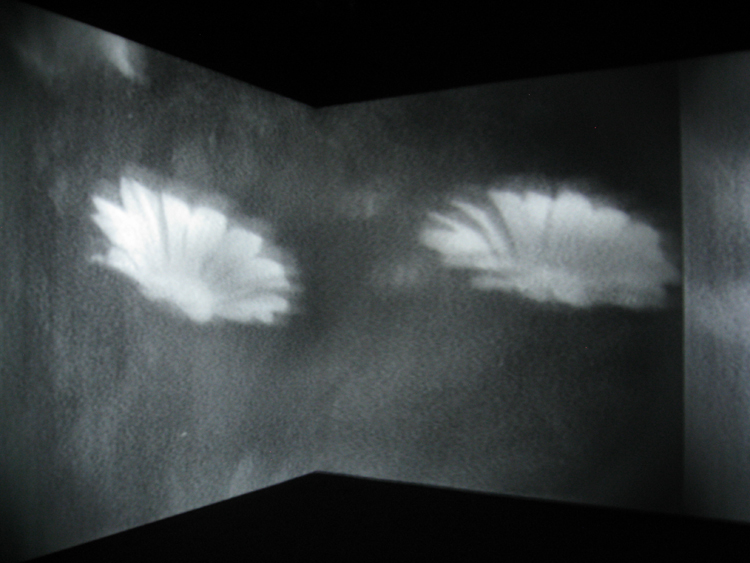
Pneuma, 1994/2009, video/sound installlation. Photo: Kira Perov © Bill Viola Studio
Twelve video works were installed together with 14 drawings and one marble by Michelangelo at the Royal Academy of Arts in London, 2019, in a major exhibition titled “Bill Viola/Michelangelo: Life, Death, Rebirth,” a dialogue betwen two artists, centuries apart, who shared related concerns. For their 1,000th year anniversary, the St Moritz Church, Augsburg, Germany, hosted an exhibition of four smaller works. In June, Ocean Without a Shore (2007) was permanently installed in PLANTA, Lleida, Spain. Seven video pieces including rarely shown He Weeps for You (1976) and Pneuma (1994/2009), were exhibited at The Barnes Foundation in Philadelphia in a show titled I Do Not Know What It Is I Am Like: The Art of Bill Viola. Later in the year, an exhibition of ten works opened at the Borusan Contemporary in Istanbul, followed by Mirrors of the Unseen in Casa Milà/La Pedrera, modernist architect Antoni Gaudi’s masterpiece in Barcelona. Satellite exhibitions of one work each were shown simultaneously in the Museum of Montserrat; in Bòlit Centre d’Art Contemporain, Girona; in the Museo Episcopal de Vic; as well as the permanent installation in PLANTA. In this Catalonia-wide celebration, further programs were scheduled at the Gran Teatre del Liceu and Palau de la Musica in Barcelona.
The exhibition at La Pedrera traveled to Espacio Fundación Telefónica in Madrid in February of 2020. Not long after opening, the coronavirus began to spread and the exhibition was closed for a time, eventually reopening. Many other projects scheduled for the year were either paused or postponed to 2021 and beyond. In spite of all the challenges and restrictions in place over the course of the year, October opened with Bill Viola: Purification at the Royal Museum of Fine Arts of Belgium in Brussels, followed by four Martyrs series works on view at the Bangkok Art Biennale in Thailand, finishing the year with a solo exhibition of sixteen works, Bill Viola, Encounter at Busan Museum of Art in South Korea. 2021 opened with a solo exhibtion at the Stavanger Art Museum, Norway, Bill Viola: Into the Light, followed by twenty-three works at The Pushkin State Museum of Fine Arts in Moscow, featuring a performance of Déserts (1994), video by Bill Viola and music by Edgard Varèse. April 2021 saw the opening of Bill Viola: Slowly Turning Narrative at the Los Angeles County Museum of Art, finishing out the year with a solo exhibition at Amos Rex in Helsinki, Finland, titled Bill Viola: Inner Journey, which opened at the end of September. At around the same time, two Bill Viola works were shown as a solo installation at the Volga-Vyatka branch of the Pushkin State Museum of Fine Arts (Arsenal) in Nizhny Novgorod, Russia.
Several solo exhibitions for 2022 included “Bill Viola: Icons of Light,” at the Palazzo Bonaparte, Rome, Italy; “Bill Viola: Tiempo Suspendido,” Ex Teresa Arte Actual,” Mexico City, Mexico, which traveled the Museo de Arte Contemporáneo de Monterrey (MARCO), Mexico. In between the two solo shows in Mexico was “Bill Viola,” at the Museum der Moderne Salzburg, Austria; ending the year with a revival of the Tristan Project with the Los Angeles Philharmonic at the Walt Disney Concert Hall. Following the presentation in Los Angeles, the production traveled to the Opéra national de Paris for a fully staged revival in January 2023. On a winter evening during the Paris Tristan revival on which there was no performance scheduled, the Philharmonie de Paris presented Edgard Varèse’s Déserts in concert, with the eponymously titled video accompaniment by Bill Viola, subsequently also performed separately in Budapest, Hungary and Madrid, Spain. The Night Journey game also featured prominently this year in a touring exhibition throughout major cities in Brazil, as well as part of group exhibitions in Ramat Gan, Israel and a game play version touring the major cities of Spain. Opening simultaneously were a large solo exhibition in the grand halls of the Palazzo Reale, Milan, and a show at James Cohan in New York featured two iconic installation works originating in the late 1970s. In October of 2023, “Bill Viola,” a large solo exhibition of 18 works opened in La Boverie, Liège, Belgium and in December, and exhibition of Moving Stillness: Mount Rainier 1979 (1979) at the Orlando Museum of Art.
Opening the year 2024, a collection of Viola’s work held by ARTISTS ROOMS was exhibited at the Royal Albert Memorial Museum & Art Gallery, Exeter, Great Britain. Followed by a series of group shows over the summer, including the Biennale d'art contemporain De Renava, Bonafacio, France (Corsica); The Sleepers (1992) on view at The Giverny Foundation for Contemporary Art, Montréal, Canada; another presentation of Moving Stillness: Mount Rainier 1979, this time at the Asheville Art Museum, North Carolina, in September.
Viola is the recipient of numerous awards and honors including a John D. and Catherine T. MacArthur Foundation Fellowship (1989). In 2006 he was awarded Commander of the Order of Arts and Letters by the French Government. In 2009 he received the XXI Catalonia International Prize in Barcelona, Spain and was awarded the Japan Art Association’s Praemium Imperiale art award in the category of painting in 2011. Viola was elected an Honorary Royal Academician in 2017.
KIRA PEROV
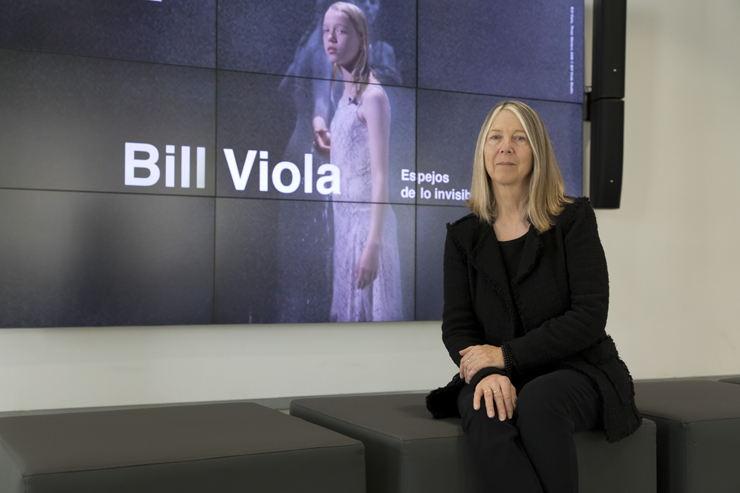
Photo: Luis Domingo
Kira Perov is executive director of Bill Viola Studio. She has worked closely with Bill Viola, her husband and partner since 1979, managing, creatively guiding and assisting with the production of all of his videotapes and installations, and photographing the process. She edits all Bill Viola publications, selecting materials from her extensive archive and collaborating with museum professionals and designers. Perov also curates, organizes and coordinates exhibitions of the work worldwide.
Kira Perov earned her Bachelor of Arts (Honors) in languages and literature from Melbourne University, Australia in 1973, and traveled extensively throughout Europe and the South Pacific, including Papua/New Guinea. In 1974 she was awarded a fellowship by the Bulgarian/Australian Friendship Commission to study the language and culture of Bulgaria, where she lived for six months before returning to Australia. When she invited Viola to Melbourne in 1977, Perov was director of cultural activities at La Trobe University, curating exhibitions and producing concerts.
Recent publications include Bill Viola: Visioni interiori, Palazzo delle Esposizioni, Rome (2008); Bill Viola (co-edited with Jérôme Neutres), Musee National, Grand Palais (2014); Hanhardt, John G. Bill Viola. Edited by Kira Perov. London and New York: Thames & Hudson (2015); Galansino, Arturo and Kira Perov eds. Bill Viola: Electronic Renaissance (exh. cat.). Florence: Giunti Arte Mostre Musei (2017); Clayton, Martin and Kira Perov, eds. Bill Viola / Michelangelo: Life Death Rebirth (exh. cat.). London: Royal Academy of Arts (2019); Yuzakova, Elizaveta, managing ed. and Kira Perov, ed. advisor. Bill Viola: The Journey of the Soul (exh. cat.). Moscow: The Pushkin Museum (2021).
Her photographs, including those documenting Viola’s work, have been widely published.
BILL VIOLA CURRICULUM VITAE
CAREER
Captain of the “TV Squad,” 5th grade, P.S. 20, Queens, New York, 1960
Independent artist since 1973
Artist-in-residence, WNET Thirteen Television Laboratory, New York, 1976-81
Lived in Japan on cultural exchange fellowship. Studied with Zen priest/painter Daien Tanaka, 1980-81
Artist-in-residence at Sony Corporation's Atsugi Laboratories, 1981
Instructor, Advanced Video, California Institute of the Arts, Valencia, California, 1983
Represented the United States at the 46th Venice Biennale in the US Pavilion, 1995
Getty Scholar-in-residence at The Getty Research Institute for the History of Art and the Humanities, Los Angeles, 1998
Elected to American Academy of Arts and Sciences, United States, 2000
Commander of the Order of Arts and Letters, France, 2006
Ocean Without a Shore created for the 56th Venice Biennale at the 15th century church of San Gallo, 2007
Self Portrait, Submerged created for the self portrait collection in the Vasari Corridor, Uffizi Gallery, Florence, 2013
Martyrs (Earth, Air, Fire, Water) created for St. Paul's Cathedral, London, 2014
AWARDS
1984 Polaroid Video Art Award for outstanding achievement, USA
1987 Maya Deren Award, American Film Institute, USA
1989 John D. and Catherine T. MacArthur Foundation Award, USA
1993 Skowhegan Medal (Video Installation), USA
1993 Medienkunstpreis, Zentrum für Kunst und Medientechnologie, Karlsruhe, and Siemens Kulturprogramm, Germany
2003 Cultural Leadership Award, American Federal of Arts, USA
2006 NORD/LB Art Prize, Bremen, Germany
2009 Eugene McDermott Award in the Arts, MIT, Cambridge, MA
2009 Catalonia International Prize, Barcelona, Spain
2011 Arents Award for Distinguished Alumni, Syracuse University, New York
2011 Praemium Imperiale, the Japan Art Association, Tokyo
2013 National Artist Award, Anderson Ranch, Snowmass Village, CO
2013 Aurora Award, Aurora Picture Show, Houston, TX
HONORARY DEGREES
1995 Degree of Doctor of Fine Arts, Syracuse University, New York, USA
1997 Degree of Doctor of Fine Arts, The Art Institute of Chicago, Illinois, USA
1998 Degree of Doctor of Fine Arts, California College of Arts and Crafts, Oakland, California, USA
1999 Degree of Doctor of Fine Arts, Massachusetts College of Art, Boston, Massachusetts, USA
2000 Degree of Doctor of Fine Arts, California Institute of the Arts, Valencia, California, USA
2000 Degree of Doctor of Fine Arts, University of Sunderland, Sunderland, England
2004 Degree of Doctor of Fine Arts, Royal College of Art, London, England
2005 Degree of Doctor of Fine Arts, Columbia College, Chicago, Illinois, USA
2006 Degree of Doctor of Fine Arts, Otis College of Art and Design, Los Angeles, California, USA
2011 Doctorate Honoris Causa, University of Liege, Belgium
SELECTED SOLO EXHIBTIONS
1973 "New Video Work," Everson Museum of Art, Syracuse, New York
1974 "Bill Viola: Video and Sound Installations," The Kitchen Center, New York 1979 "Projects: Bill Viola," The Museum of Modern Art, New York
1983 "Bill Viola," ARC, Musée d'Art Moderne de la Ville de Paris, France
1985 "Summer 1985," Museum of Contemporary Art, Los Angeles
1985 "Bill Viola," Moderna Museet, Stockholm, Sweden
1987 "Bill Viola: Installations and Videotapes," The Museum of Modern Art, New York
1988 "Bill Viola: Survey of a Decade," Contemporary Arts Museum, Houston, Texas
1989 "Bill Viola," Fukui Prefectural Museum of Art, Fukui City, Japan, part of The 3rd Fukui International Video Biennale.
1990 "Bill Viola: The Sleep of Reason," Fondation Cartier pour l'Art Contemporain, Jouy-en-Josas, France
1992 "Bill Viola: Nantes Triptych," Chappelle de l'Oratoire, Musée des Beaux-Arts, Nantes, France
1992 "Bill Viola," Donald Young Gallery, Seattle, Washington (five installations)
1992 "Bill Viola: Two Installations," Anthony d'Offay Gallery, London, England
1992 "Bill Viola. Unseen Images," Stadtische Kunsthalle Düsseldorf, Düsseldorf, Germany. Travels to: Moderna Museet, Stockholm, Sweden (1993); Museo Nacional Centro de Arte Reina Sofia, Madrid, Spain (1993); Musée Cantonal des Beaux-Arts, Lausanne, Switzerland (1993); Whitechapel Art Gallery, London, England (1993), Tel Aviv Museum of Art, Israel (1994)
1994 "Bill Viola: Stations," American Center inaugural opening, Paris, France
1994 "Bill Viola: Território do Invisível/Site of the Unseen," Centro Cultural/Banco do Brazil, Rio de Janeiro, Brazil
1995 "Buried Secrets," United States Pavilion, 46th Venice Biennale, Venice, Italy. Travels to Kestner-Gesellschaft, Hannover, Germany (1995); Arizona
State University Art Museum (1996)
1996 "Bill Viola: New Work," Savannah College of Art and Design, Savannah, Georgia (installation)
1996 "Bill Viola: The Messenger," Durham Cathedral, Visual Arts UK 1996, Durham, England. Travels to South London Gallery, London, England (1996); Video Positiva-Moviola, Liverpool, England; The Fruitmarket Gallery, Edinburgh, Scotland; Oriel Mostyn, Gwynedd, Wales; The Douglas Hyde Gallery, Trinity College, Dublin, Ireland (1997)
1996 “Bill Viola: Trilogy: Fire, Water, Breath,” Chapelle Saint-Louise de la Salpetrière, Festival d’Automne, Paris
1997 “Bill Viola: Fire, Water, Breath,” Guggenheim Museum (SoHo), New York
1997 “Bill Viola: A 25-Year Survey” organized by the Whitney Museum of American Art. Travels to Los Angeles County Museum of Art; Whitney Museum of American Art, New York (1998); Stedelijk Museum, Amsterdam (1998); Museum für Moderne Kunst, Frankfurt, Germany (1999); San Francisco Museum of Modern Art, California (1999); Art Institute of Chicago, Illinois (1999-2000)
2000 “The World of Appearances,” Helaba Main Tower, Frankfurt, Germany (permanent installation)
2000 “Bill Viola: New Work,” James Cohan Gallery, New York
2001 “Bill Viola: Five Angels for the Millennium,” Anthony d'Offay Gallery, London
2002 "Bill Viola: Going Forth By Day," Deutsche Guggenheim, Berlin
2003 "Bill Viola: The Passions," Getty Museum, Los Angeles
2003 "Bill Viola," Kukje Gallery, Seoul, Korea
2003 "Bill Viola: Five Angels for the Millennium," Ruhrtriennale, Gasometer, Oberhausen, Germany
2003 "Bill Viola: The Passions," National Gallery, London
2004 "Bill Viola: Temporality and Transcendence," Guggenheim, Bilbao, Spain
2005 "Bill Viola: The Passions," Fundación "la Caixa," Madrid, Spain; and National Gallery of Australia, Canberra
2005 "Bill Viola Visions," ARoS Aarhus Kunstmuseum, Aarhus, Denmark
2005 "Bill Viola," James Cohan Gallery, New York, USA
2005 "Tristan und Isolde," fully staged opera premiere at the Opéra National de Paris, France
2006 "Bill Viola – Video", 2006 Recipient of the NORD/LB Art Prize, Kunsthalle Bremen, Bremen, Germany
2006 "LOVE/DEATH The Tristan Project," Haunch of Venison, and St. Olave’s College (two venues), London, UK
2006 “Bill Viola: Hatsu-Yume (First Dream),” Mori Art Museum, Tokyo, Japan
2007 “Bill Viola: Las Horas Invisibles,” Museo de Bellas Artes de Granada, Palacio de Carlos V (Alhambra), Spain
2007 “Bill Viola,” Zacheta National Gallery of Art, Warsaw, Poland
2007 “Ocean Without a Shore,” Church of San Gallo, Venice, Italy
2008 “Bill Viola: The Tristan Project,” Art Gallery of New South Wales, and St Saviour’s Church, Sydney, Australia
2008 “Bill Viola: Transfigurations.” Kukje Gallery, Seoul, Korea
2008 “Ocean Without a Shore,” National Gallery of Victoria, Australia
2008 “Bill Viola: Visioni interiori,” Palazzo delle Esposizioni, Rome, Italy
2009 “Bill Viola: Bodies of Light,” James Cohan Gallery, New York, New York, USA
2009
“Bill Viola: The Intimate Work,” De Pont Museum of Contemporary Art, Tilburg, Netherlands
2009
“Bill Viola: Being Time,” The Pier Arts Center, Stromness, Orkney, Scotland, UK
2009
“Bill Viola: Installations and Screenings” (Screenings part of Forum Expanded, 59th Berlinale), Haunch of Venison, Berlin, Germany
2010 “Bill Viola per Capodimonte,” The Museo di Capodimonte of Naples, Naples, Italy
2010 “Bill Viola: The Quintet of the Astonished,” Urban Video Project, Syracuse University, Syracuse, New York, USA
2010 “Emergence: Bill Viola at the Accademia Gallery,” Galleria dell'Accademia, Florence, Italy
2010 “Bill Viola: Figurative Works,” Museo Picasso Málaga, Spain
2010 “Bill Viola: Fire Woman and Tristan’s Ascension,” Presented by Kaldor Public Art Projects in association with the Melbourne International Arts Festival; St. Carthage's Church, Melbourne, Australia
2010 “Bill Viola: The Raft,” Presented by ACMI for the Melbourne International Arts Festival in association with Kaldor Public Art Projects, Melbourne, Australia
2011 “Bill Viola: Quintet of the Unseen,” Blain|Southern, London, UK
2011 “Bill Viola: Liber Insularum,” Sala de Arte Contemporaneo del Gobierno de Canarias, Tenerife, Canary Islands, Spain
2011 “Bill Viola: Transformations,” Gallery Koyanagi, Tokyo, Japan
2011 “Amore e Morte,” Gucci Museum, Florence, Italy
2011 “Ocean Without a Shore,” Pennsylvania Academy of the Fine Arts (PAFA), Philadelphia. Pennsylvania, USA
2012 “Bill Viola: The Raft,” Nelson-Atkins Museum, Kansas City, Missouri, USA
2012 “Bill Viola: Unspoken,” James Cohan Gallery, Shanghai, China
2012 “Bill Viola: Submerged-Spaces,” Norfolk & Norwich Festival, Sainsbury Centre for Visual Arts, Norwich, UK
2012 “Bill Viola: Reflections,” Villa di Panza, Varese, Italy
2012 “Bill Viola: Water,” Nordic Watercolor Museum, Skarhamn, Sweden
2012 “Bill Viola: Liber Insularum,” Museum of Contemporary Art North Miami, Florida, USA
2013 “Bill Viola: Ascension,” Wadsworth Atheneum, Hartford, Connecticut, USA
2013 “Frustrated Actions and Futile Gestures,” Blain|Southern, London, UK
2013 “Bill Viola: The Return,” Art Gallery of South Australia, Adelaide, Australia
2013 “Point of Departure,” Parque de La Memoria, Buenos Aries, Argentina
2014 “Tristan und Isolde,” Teatro Real, Madrid, Spain
2014 “Bill Viola: In Dialogue,” Real Academia de Bellas Artes de San Fernando Madrid, Spain
2014 “Bill Viola,” Galeries Nationales du Grand Palais, Paris, France
2014 “Revival of Tristan at La Bastille,” Opera Bastille, Paris, France
2014 “Bill Viola: Passions,” Cathedral of Berne & Kunstmuseum Bern, Switzerland
2014 “Martyrs (Earth, Air, Fire, Water),”(Permanent), St. Paul’s Cathedral, London, UK
2014 “Bill Viola: Transformation,” Faurschou Foundation, Beijing, China
2015 "Bill Viola: Selected Works,” Art Gallery of South Australia, St. Peter’s Cathedral, and Queen’s Theatre, organized by Adelaide Festival of Arts, Adelaide, Australia
2015
“Masterpiece 2015: Bill Viola,” De Nieuwe Kerk, Amsterdam, The Netherlands
2015
“Bill Viola,” Kukje Gallery, Seoul, Korea
2015
“Bill Viola,” Yorkshire Sculpture Park, Wakefield, West Yorkshire, UK
2015 “Bill Viola: Moving Stillness (Mt. Rainier), 1979,” Blain|Southern, London, UK
2015 “Bill Viola: The Talking Drum” at The Vinyl Factory Space at Brewer Street Car Park in Soho, London, UK
2016 “Mary,” St. Paul’s Cathedral, London, UK (permanent installation)
2016 “Bill Viola: The Moving Portrait,” National Portrait Gallery, Washington, DC, USA
2017 “Bill Viola: Electronic Renaissance” (cat.), Palazzo Strozzi, Florence, Italy
2017 “Bill Viola: Installations” (cat.), Deichtorhallen, Hamburg, Germany
2017 “Bill Viola: A Retrospective,” Guggenheim Bilbao Museum, Spain
2017 “Bill Viola: Visitation Reformation,” Uppsala Cathedral, Uppsala, Sweden
2017 “Bill Viola: Selected Work 1977-2014” (cat.), Redtory Museum of Contemporary Art, Guangzhou, China
2017 “Naissance á rebours,” DHCArt, Montreal, Canada
2018 “Moving Stillness,” James Cohan Gallery, New York
2018 “Bill Viola: Visions of Time,” SESC (Serviço Social do Comércio), São Paolo, Brazil
2018 “Bill Viola,” La Nave Salinas, Ibiza, Spain
2018 “Bill Viola: Vía Mística,” Iglesia de San Miguel, Iglesia de San Andres, Iglesia de Las Angelicas, Museo de Arte Abstracto Español en Cuenca; Cuenca, Spain
2019 “Bill Viola / Michelangelo: Life, Death, Rebirth,” Royal Academy of Arts, London, UK
2019 “Intimate Works,” Blain|Southern, London, UK
2019 “Body of Time,” Museo Provincial de Bellas Artes Franklin Rawson, San Juan, Argentina
2019 “I Do Not Know What It Is I Am Like,” Barnes Foundation, Philadelphia, PA, USA
2019 “Impermanence,” Borusan Contemporary, Istanbul, Turkey
2019 “Mirrors of the Unseen,” Casa Milà / La Pedrera, Barcelona, Spain
2020 “Mirrors of the Unseen,” Espacio Fundación Telefónica, Madrid, Spain
2020 “Bill Viola: Purification,” Royal Museum of Fine Arts of Belgium, Brussels, Belgium
2020 “Bill Viola, Encounter,” Busan Museum of Art, Busan, South Korea
2021 “Bill Viola: Into the Light,” Stavanger Art Museum, Stavanger, Norway
2021 “Bill Viola: Journey of the Soul,” The Pushkin State Museum of Fine Arts, Moscow, Russia
2021 “Bill Viola: Slowly Turning Narrative,” Los Angeles County Museum of Art, Los Angeles, CA, USA
2021 "Bill Viola: Inner Journey," Amos Rex, Helsinki, Finland
2022 “Bill Viola: Icons of Light," Palazzo Bonaparte, Rome, Italy
2022 “Bill Viola: Tiempo Suspendido,” Ex Teresa Arte Actual,” Mexico City, Mexico
2022 “Bill Viola," Museum der Moderne Salzburg, Austria
2022 “Bill Viola: Tiempo Suspendido,” Museo de Arte Contemporáneo de Monterrey (MARCO), Mexico
2023 “Bill Viola," Palazzo Reale, Milan, Italy
2023 “Bill Viola,” James Cohan, New York, USA
2023 “Bill Viola: Sculptor of Time,” La Boverie, Liège, Belgium
2024 “ARTIST ROOMS Bill Viola,” Royal Albert Memorial Museum Art Gallery, Exeter, UK



